
What does Raymond Chung look at first when a suit doesn't fit right?
Raymond Chung reads the whole suit first: balance, hang, posture and proportion. The obvious wrinkle may only be a symptom. A proper suit fitting diagnosis asks why the garment is pulling, lifting or gaping before deciding whether alteration, recutting or pattern refinement is realistic.
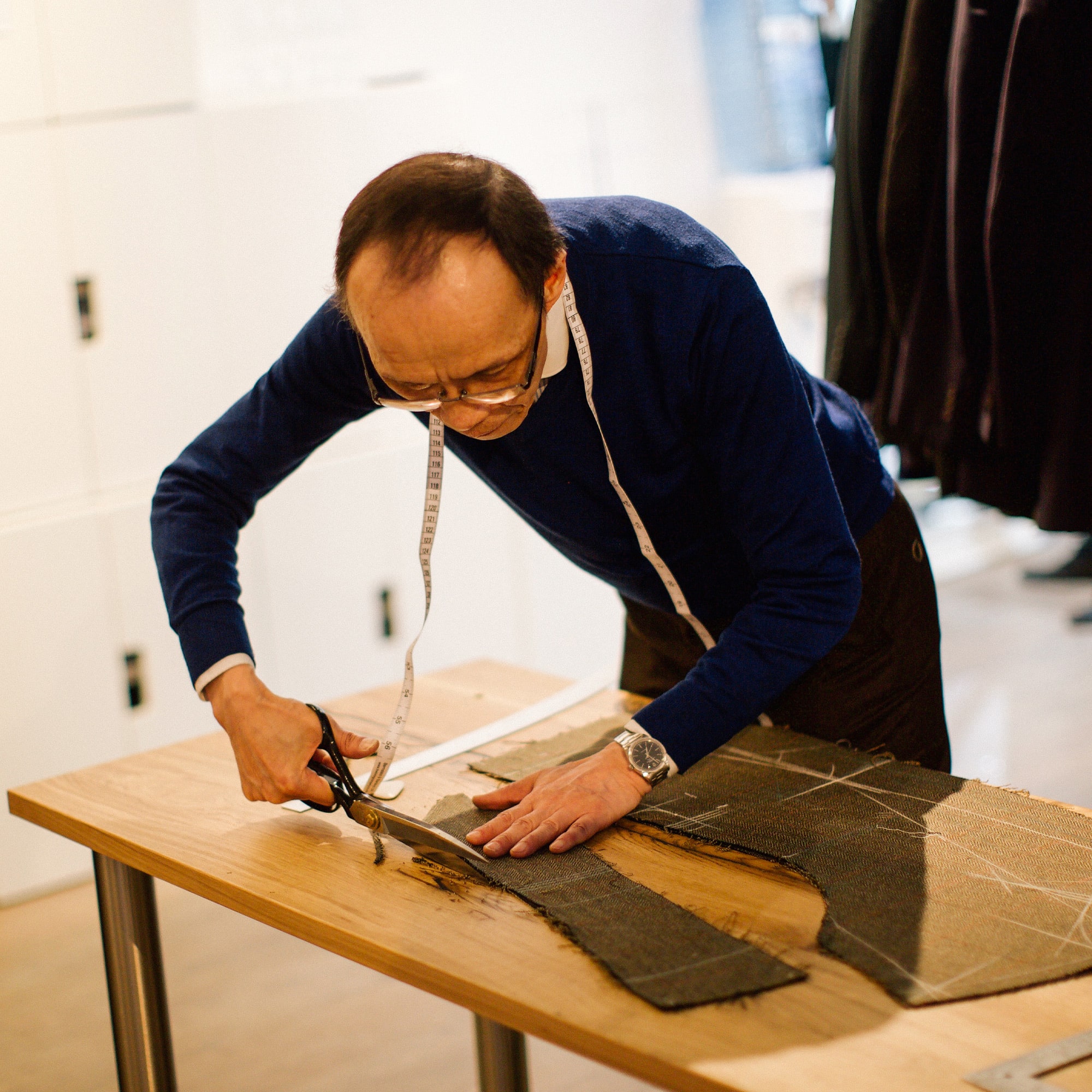
Raymond Chung cutting a bespoke suit
What Is In This Article
Start with the whole jacket before chasing the obvious flaw
A client may point straight to a collar gap, a tight buttoning point or a sleeve that twists, but a cutter usually steps back before touching the cloth. The first useful question is how the jacket sits as a complete garment. If the coat is not hanging cleanly from the upper body, small visible faults may be clues rather than separate defects.
Raymond Chung, described by Fielding & Nicholson as a master tailor with decades of bespoke suit-making experience, gives a useful lens for this kind of fitting. His work spans measurement discussion, cutting, stitching and refinement, so the diagnosis is likely to start with cause and effect rather than a quick visual correction.
A practical suit fit check often follows this order:
- Check how the jacket hangs overall.
- Read the wearer’s posture.
- Look at shoulders and collar.
- Test the chest, lapels and buttoning point.
- Finish with trousers and small refinements.
That order matters because a suit jacket can feel off in one area after the trouble began somewhere else. Off-the-peg garments use standardised proportions, and even current clothing size language, such as ISO 8559-2:2025, is still built around body measurements rather than the full way a person stands and moves. A cutter reads the garment in motion and at rest, then decides which signs deserve attention first.
Read posture and balance as the cause behind the fit problem
Balance is the relationship between the jacket’s front length, back length and the wearer’s posture. The Savile Row Bespoke Association defines balance in tailoring as adjusting the back and front lengths of a jacket so they work with posture, which means the coat must agree with the body underneath it.
Someone with a forward stance can make the front of a jacket appear short or strained. Another person may stand very upright, causing the back to behave differently. An uneven shoulder or habitual stance can make one side look cleaner than the other, even when the measurements seem close on paper.
Balance is also easy to mistake for tightness. A jacket pulling when buttoned may need room, but it may also be reacting to the angle at which the cloth is being asked to sit. A collar that shifts away from the shirt collar can point to posture, back shape or jacket balance before it points to the collar itself.
Good fitting language treats posture as normal variation, not as a fault in the wearer. The garment has to be cut for the person in front of the mirror, not for a neutral diagram of a body.
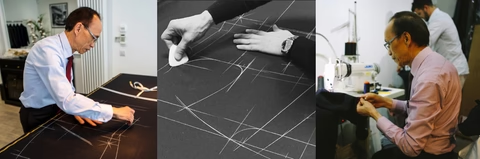
Raymond Chung in action making bespoke clothing
Check shoulders and collar as connected signals
Shoulders and collar sit close together, so one often explains the other. A client may ask whether the shoulders on a suit fit, or whether a collar gap is fixable, but a cutter first asks what is causing the gap, the dent or the lift.
What the client sees might be a jacket collar sitting away from the shirt collar, shoulder dents, cloth folding near the sleeve head or a coat that feels wrong across the upper back. Those signs are useful, but they do not all call for the same alteration.
What the cutter checks is the shoulder line, the angle of the neck, the upper back and the way the sleeve is set into the armhole. Shoulder work can be difficult and disruptive, so it is often treated as more than a simple sleeve or trouser adjustment. A clean diagnosis matters because changing the wrong point can move the problem rather than solve it.
Raymond Chung’s role as a Head Cutting Consultant makes this distinction especially relevant. The issue may look like a collar fault, but the decision may sit in the cut of the upper back, the shoulder slope or the balance of the jacket. That is why a master cutter suit fit assessment can sound more measured than a simple yes or no answer.
Pro Tip: Read collar, shoulders and upper back together before deciding on an alteration. A collar gap often points to balance or posture, so the visible issue may sit somewhere else in the jacket.
Trace chest, lapels and trousers back to the right cause
Once the upper structure has been read, the jacket front and trousers give further evidence. Button strain, lapel bowing and trouser drag can all look like simple tightness, but each can come from distribution, posture, construction or incomplete refinement.
Read chest and lapels as tension signals
Chest fit should be judged by how the front of the jacket rests, fastens and moves. If the buttoning point strains, the waist may be too close, yet the chest or balance may be part of the same issue. A small alteration at the waist will not give a clean result if the cloth is being pulled from higher up.
Lapel bowing gives another warning sign. A lapel should sit in a controlled line, but bowing can reflect tension through the chest, pressure from the shoulder area or an imbalance in the front. During a baste fitting, which the Savile Row Bespoke Association describes as a rough assembly for a first fitting, these points can be assessed before the garment is fully finished.
Finished suits give less freedom. Once the inner structure, seams and cloth have been set, every change has to respect what the garment can still allow.
Judge trousers through seat, thigh, hem and movement
Trousers deserve the same diagnosis as the jacket. The waist may feel right, but the seat can pull, the thigh can restrict movement or the hem can break in a way that makes the line look untidy. Judging only the waistband misses much of what makes trousers comfortable and balanced.
Movement matters here. A trouser that stands neatly still may feel wrong when sitting, walking or climbing stairs. Fit through the seat and thigh decides whether the cloth has enough ease to work, while the hem and break refine the final line after the larger points are settled.
Small refinements still count, but they should come late in the fitting logic. Sleeve length, cuff show, trouser hem and final shaping make sense after the cutter knows the garment is sitting correctly on the body.
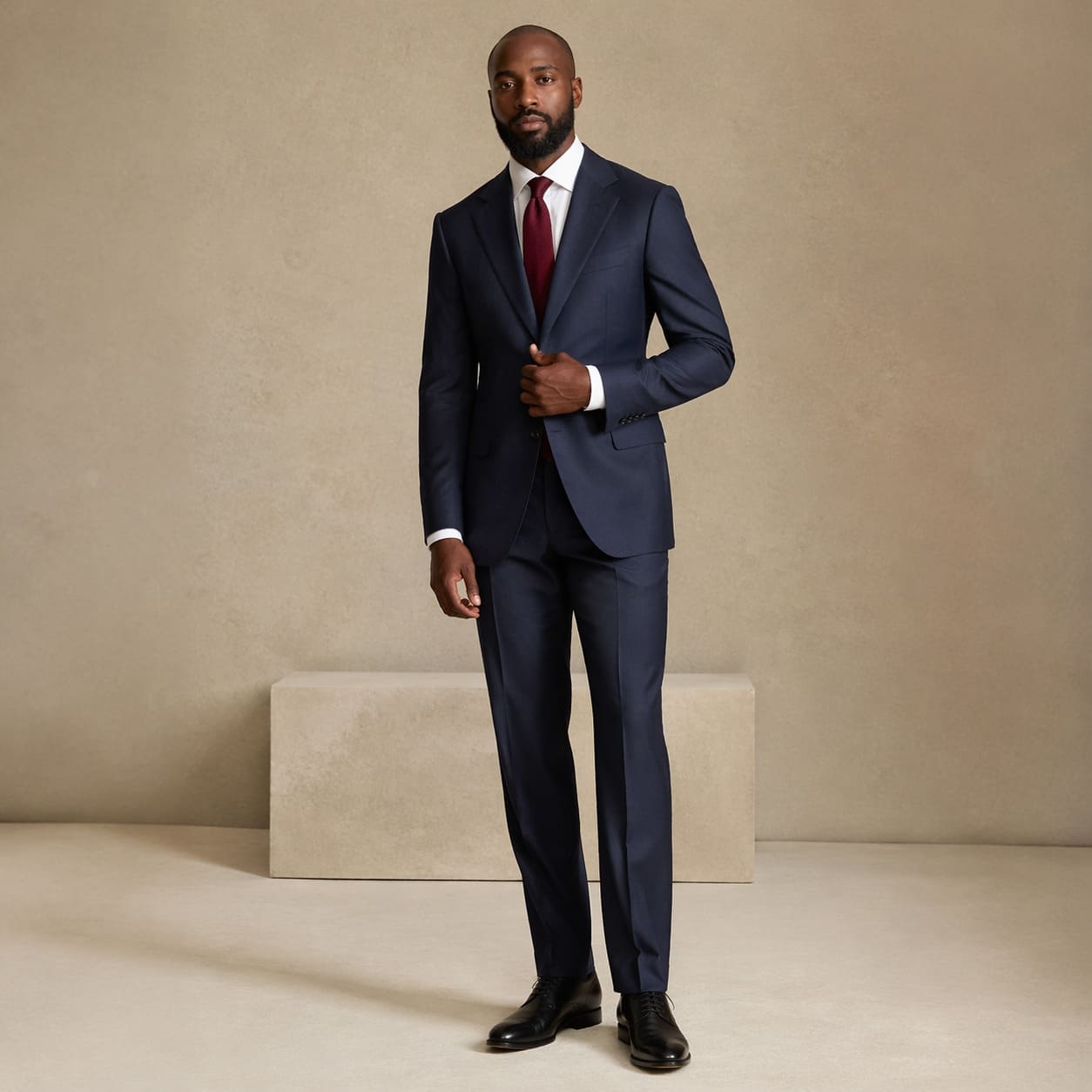
Men's Bespoke Suits – Navy tailored suit with white shirt and tie – Sample Image

Pro Tip: Treat trousers as part of the same fit diagnosis as the jacket. Seat, thigh and hem can confirm whether the garment needs a small refinement or a more fundamental pattern correction.
Separate alteration problems from pattern problems
A finished suit and a bespoke pattern are different kinds of fitting question. Alterations work within an existing garment, but pattern correction changes the instructions behind future garments and can address repeated fit issues at the source.
The distinction is easier to see when common fit points are grouped by the kind of work they often suggest.
| Usually more straightforward to refine | Often points to deeper construction or pattern work |
|---|---|
| Sleeve length adjustments | Shoulder line problems |
| Trouser hems | Jacket balance issues |
| Some waist shaping | Collar gaps caused by posture or back shape |
| Minor trouser fit refinements | Repeated pulling through chest, back or seat |
| Final finishing details | A personal pattern that does not yet reflect the wearer accurately |
No table can decide a garment on its own. Cloth allowance, construction method and the condition of the suit all affect what is sensible. A small change can be enough in one jacket and unwise in another that shows the same visible symptom.
Pattern-led fitting gives a different route. The Savile Row Bespoke Association says a bespoke suit uses a customer-specific pattern, requires a series of fittings and involves a minimum of 50 hours of hand work. Fielding & Nicholson describes its own bespoke process in similar sequence, moving from consultation, measurements and cloth choice into cutting, assembly and multiple fittings. In practical terms, that means a recurring collar issue, balance problem or trouser fit point can be recorded and refined over time rather than treated as a fresh alteration each time.
That is the useful decision for a client: whether the suit needs a proportionate adjustment now, or whether the pattern behind future garments should be corrected.
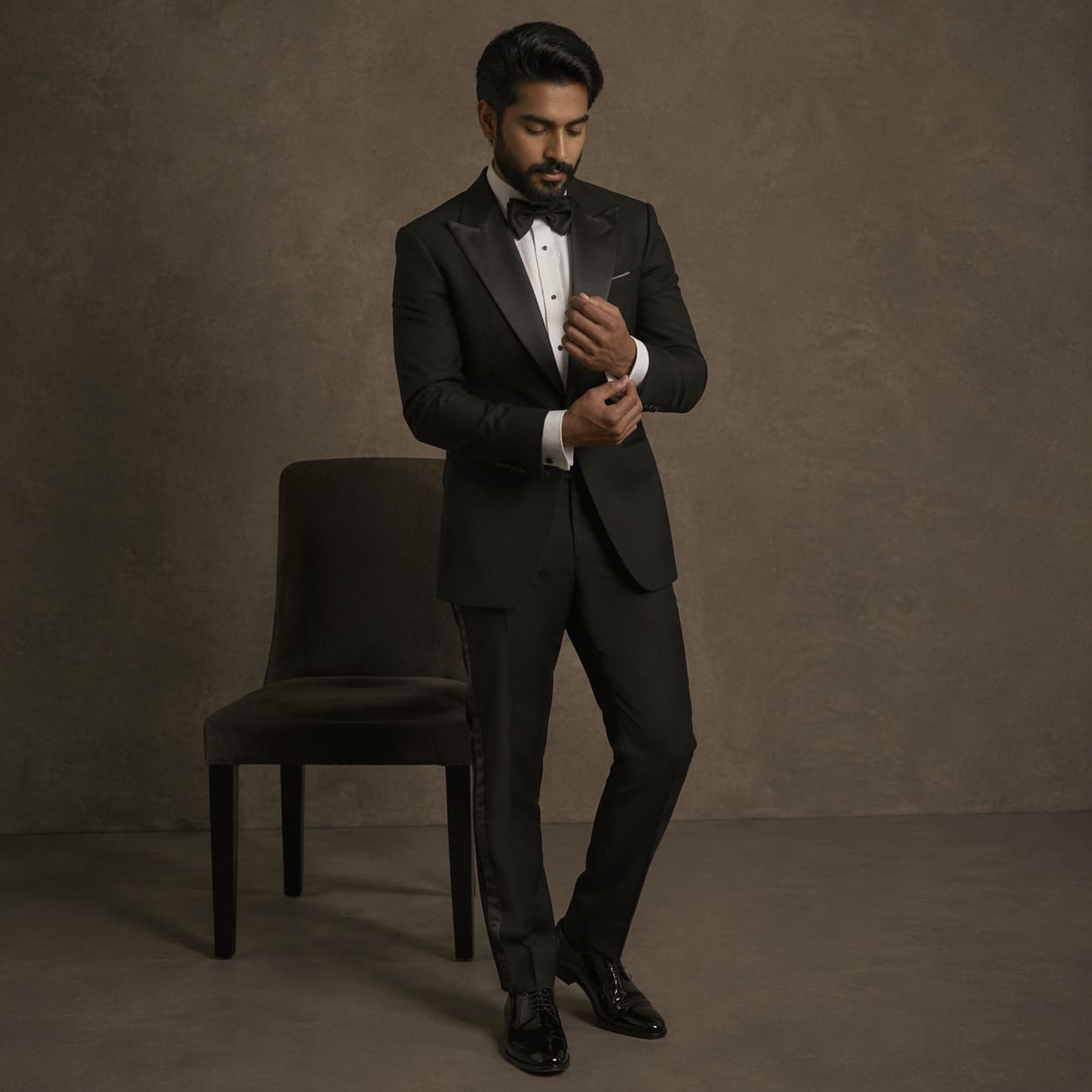
Men's Bespoke Suits – Black tuxedo with bow tie – Sample Image
Expect fit language to become more precise
Clothing size language is becoming more exact,.clearer measurement terms can help people describe bodies more consistently, but measurements alone do not diagnose balance. A tape can record the body; a fitting interprets how cloth must behave on that body. Posture, movement, shoulder slope and long-term fitting notes will matter more as clients become less willing to accept a suit that is merely close in size.
The sharper distinction is simple: size describes, fitting interprets. Better fitting over the next few years will depend on how well tailors combine precise records with judgement about the individual pattern, especially for clients building a wardrobe garment by garment.
Frequently asked questions
Why does my suit jacket feel wrong even when it is the right size?
A suit can be close in size but still wrong in balance, posture or proportion. The jacket may pull, lift or gape because it is not working with the way the wearer stands and moves.
Should a suit jacket collar touch the shirt collar?
A jacket collar should sit cleanly against the shirt collar in normal wear. If it pulls away, the cause may sit in posture, the upper back, the shoulder line or the jacket balance.
Can a tailor fix suit shoulders?
Shoulder work can sometimes be altered, but it is usually more involved than adjusting sleeves, hems or some waist shaping. A tailor should first identify whether the shoulder itself is the cause or whether another part of the jacket is creating the symptom.
How can I tell whether a suit is too big or too small?
A suit may be too big if it collapses, drapes poorly or has excess cloth in key areas. A suit may be too small if it pulls at the button, restricts movement or creates tension across the chest, seat or thighs.
Why do bespoke fittings improve fit over time?
Bespoke fittings create and refine a customer-specific pattern. Each fitting can record how the wearer stands, moves and prefers the garment to sit, which makes future adjustments more precise.