How should your suit sit when you stand and move?
A suit fits well when the jacket and trousers stay balanced on your body as you stand, sit and move. The collar, shoulders, sleeves, waist, seat and hem all matter, and each checkpoint only makes sense after we have seen how the whole garment behaves.
Most suit fit problems show up as something small: a collar lifting away from the shirt, a sleeve twisting, a trouser hem folding badly over the shoe. The useful question is what caused that visible fault. A clean alteration depends on reading the cause first.
Fit also changes with use. A jacket can look fine when you stand square to a mirror, then pull across the back when you reach forward. Trousers can feel comfortable at the waist, then catch through the seat when you sit. We look at both the still shape and the movement.
Good suit fit is a sequence. Start at the collar and shoulders, work through the jacket, then finish with the trouser body before setting the hem.

Man wearing a light blue linen suit with a white open-collar shirt, woven tan belt, patterned pocket square and brown suede tassel loafers for refined Pitti Uomo summer tailoring.
Fit diagnosis starts with the whole suit
You stand in front of the mirror and the eye goes straight to the obvious fault. Perhaps the collar is gaping. Perhaps the button pulls. Perhaps the sleeve twists as soon as your arm hangs naturally.
We start with balance across the whole suit, not with the crease that first catches your eye. A single wrinkle rarely tells the full story, because the jacket is held together by balance, hang, posture and proportion. Visible pulling, lifting and gaping are clues to read in context.
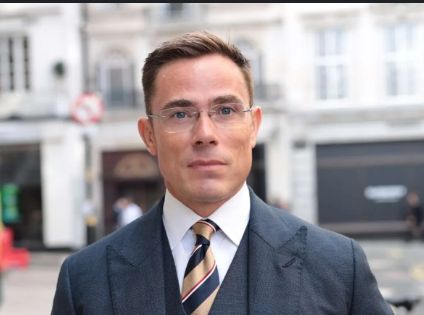
In the Mayfair showroom on Sackville Street, just off Savile Row, at Fielding & Nicholson we treat a tailor suit fitting as a diagnosis before we discuss an alteration. Raymond Chung, our Head Cutting Consultant, reads the way the suit sits across the body before isolating one fault. That is especially important with a bespoke suit fit, where the pattern and the wearer’s posture have to work together.
A good fit check starts by reading the whole garment, then deciding which visible signs matter.
Collar and shoulders belong together
Collar and shoulder fit should be assessed as one group because the shirt collar, jacket collar, upper back and shoulder line all affect each other. A jacket collar should sit cleanly against the shirt collar in your normal posture, without lifting away when you turn or settle your stance.
A collar gap can come from posture, upper back shape, shoulder line or jacket balance. Changing the collar alone can leave the real cause untouched. We look at the way the cloth rests across the back of the neck, then follow that line out across the shoulders.
Clean shoulders sit close to your natural shoulder line. They should avoid collapse at the top of the sleeve, overhang beyond your shoulder end and sharp divots under the sleeve head. Men, women and non-binary clients all need the same quality of reading here. The jacket has to suit the person wearing it, not a stock idea of who a suit is for.
Shoulder work needs care. A tailor can assess whether it is possible, but it sits in a different category from shortening a trouser hem or adjusting a sleeve length. Have collar and shoulders assessed together before you decide what should be changed.
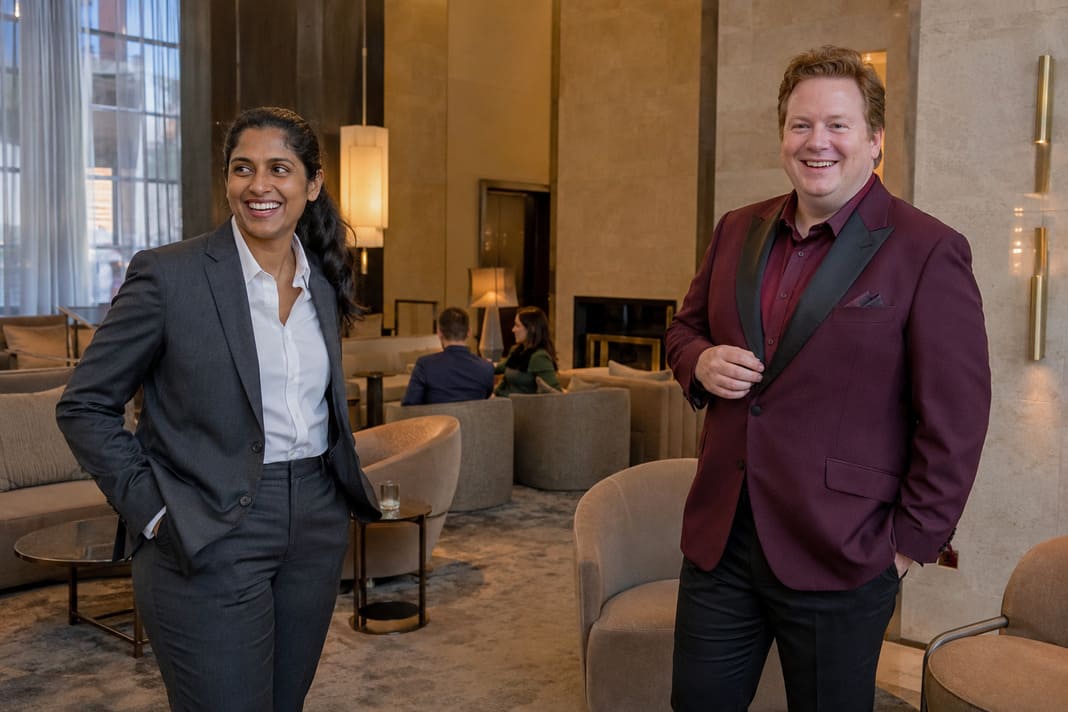
A charcoal tailored trouser suit with an open-collar shirt is paired alongside a burgundy blazer with dark tailored trousers, showcasing bespoke tailoring that embraces different personalities, body proportions, professional wardrobes and individual style preferences.
Pro Tip: Bring the shirt and shoes you plan to wear most often, then take a quick side and back photograph in natural light after the fitting. Those details make later comparisons far easier.
Sleeve pitch changes how length reads
A sleeve can look long when your arm hangs still, then twist as soon as you move. That usually tells us to check sleeve pitch, which means the angle at which the sleeve is set into the jacket.
Cuff show is a guide to proportion and preference. Some clients want a sharper line of shirt cuff; others prefer a quieter finish. The cleaner test is whether both sleeves hang evenly with your arms relaxed, then behave properly when your hands move forward.
Diagonal drag lines, twisting around the forearm and strain at the armhole all point to the sleeve setting. Shortening the sleeve first can tidy the end of the cuff and still leave the sleeve fighting your arm.
During a fitting, stand naturally, let your arms fall, then make a small reach as you would at a desk or over a table. Ask us to assess the sleeve setting before trimming cloth from the cuff.
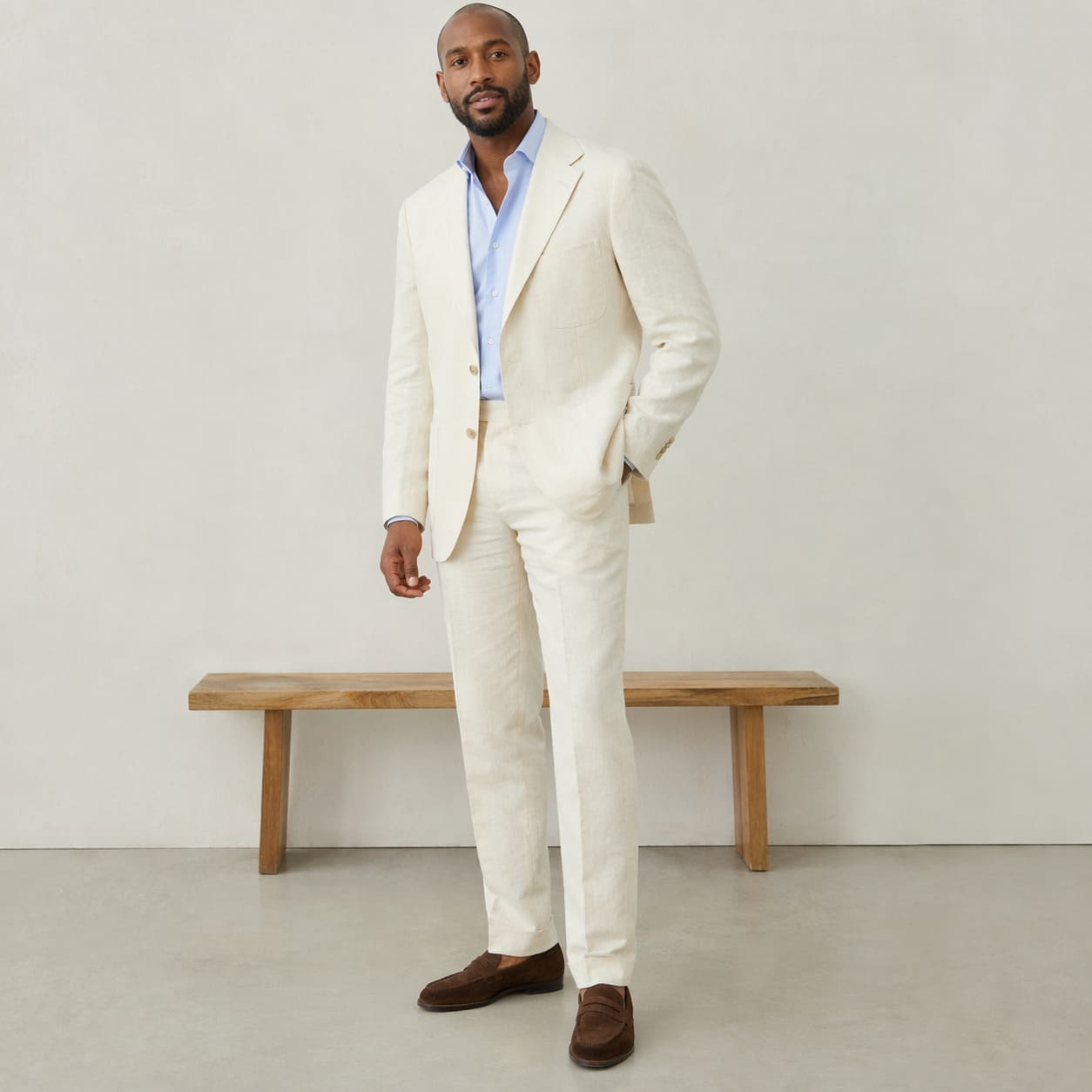
Menswear for Wimbledon – Cream tailored suit with open-collar shirt – Sample Image
Trousers fit from seat to hem
Trouser length is the final check because the hem only behaves properly after the trouser body is right. A waistband can feel comfortable while the seat pulls, the thigh restricts movement or the hem breaks untidily.
- Waist. The trouser should sit where it is intended to sit on you, without needing a belt to rescue the fit. Comfort at the waistband alone does not prove the rest is right.
- Seat. Check the back view and then sit down. Pulling across the seat, pocket flare or a feeling that the trouser is being dragged out of place all matter.
- Thigh. You need room to walk, sit and climb stairs without the cloth straining. Too much room can also disturb the line, especially if the trouser is meant to be neat.
- Rise. The rise is the distance from the waistband to the crotch seam. It affects comfort, proportion and how the jacket and trouser meet.
- Taper. The taper should follow the leg line without catching at the calf. A narrow lower leg can make the trouser hang badly even when the waist and seat are sound.
- Break. Trouser break is the fold where the hem meets the shoe. No break, half break and fuller break are choices shaped by cloth, shoe and the line you prefer.
- Shoe check. Bring the shoes you expect to wear, because they help set the suit trouser hem accurately. A different shoe shape can change where the cloth lands.
Once the waist, seat, thigh and rise work together, the hem can be set with far more confidence.

Pro Tip: Ask the tailor to mark the exact point where the jacket starts to pull when you sit and when you reach forward. That record helps separate a simple alteration from a pattern issue next time.
Alterations have limits and value
The right alteration can rescue a good suit that is slightly off. The wrong alteration can spend money on the symptom and leave the same problem showing elsewhere. We care about that distinction because suit alterations have value only when they suit the garment.
Simple work is easier to judge. Trouser hems, trouser waist adjustments, trouser seat adjustments and jacket sleeve length are common alteration discussions. Our current alteration prices list trouser hems, trouser waist and trouser seat work at £40, and jacket sleeve length at £80. Prices may change for unusual or complex work. We confirm the price before we start.
Jacket structure needs a slower reading. Shoulder adjustment and sleeve pitch adjustment are each listed at £160, and new collar work is listed at £100. Those figures make the practical point clear: these are careful jacket decisions, because the cost and disruption rise when the fault sits deeper in the cut.
The table below compares common alteration issues with fit issues that need deeper pattern or jacket assessment.
| Fit issue | Usual route |
|---|---|
| Trouser hem, waist or jacket sleeve length | Routine alteration assessment |
| Collar, shoulder line or sleeve pitch | Tailor diagnosis before work |
| Repeated pulling across several suits | Better pattern through made to measure or fully bespoke |
In practice, at Fielding & Nicholson we separate alteration potential from pattern problems early in the conversation. Icon Collection is made to measure, which means an adjusted base pattern is cut to your measurements. Gallery Collection is fully bespoke, which means a pattern is built for you.
The best result may come from a cleaner pattern, not from asking more alterations to do the same job. Diagnosis decides value: alter the suit when the suit can be improved, and change the pattern when the cause keeps repeating.
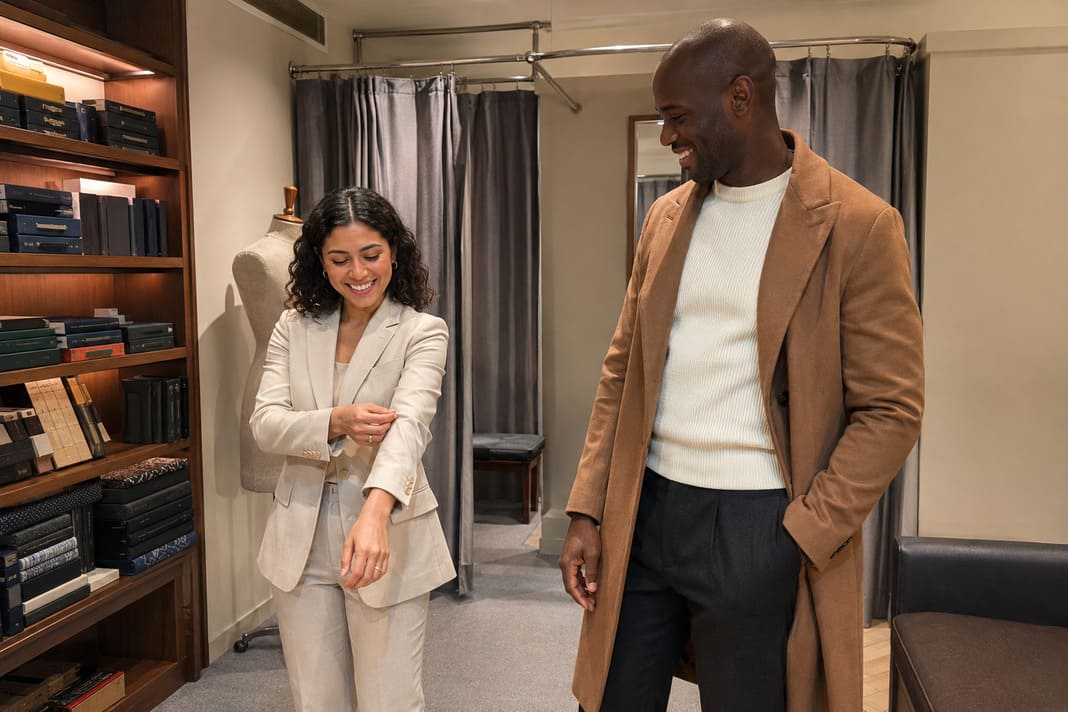
A camel blazer with dark tailored trousers creates a relaxed smart-casual look for the man, while the woman wears an ivory trouser suit with soft tailoring, demonstrating bespoke clothing designed for different body shapes, personal styles and fit preferences.
Questions clients ask us about suit fit
Can I judge suit fit from a photograph?
A photograph helps you spot obvious pulling, collar gap or trouser break, but it cannot show the full fit. We still need to see how the suit behaves when you stand naturally, sit and move.
Why does my jacket pull when it is buttoned?
Pulling at the button can come from the chest, waist, balance or posture. A cleaner fit starts by checking how the jacket hangs before deciding whether cloth should be taken in or let out.
Should both jacket sleeves look exactly the same?
Sleeves should look balanced, but your arms and posture may not be perfectly symmetrical. We judge the sleeve by how it hangs on you and how it moves, rather than forcing both sides to copy each other blindly.
Does made to measure fit the same as fully bespoke?
Made to measure adjusts an existing base pattern to your measurements. Fully bespoke uses a pattern built for you, which gives more room to solve repeat fit issues linked to posture, balance and proportion.
Should trouser pockets lie flat?
Trouser pockets should sit cleanly during normal standing and movement. If they flare or pull open, we look at the seat, thigh and rise before blaming the pocket itself.