Where does your suit belong when the fit needs changing?
Send cleaning, pressing and very simple fixes to a skilled garment care service, and take fit changes and jacket work to a tailor. We judge the route by the alteration’s depth, the suit’s structure, its value and the risk around the occasion where you plan to wear it.
Most mistakes happen because several different suit jobs get treated as one errand. A stained jacket, a tired trouser crease and a sleeve that sits badly on the wrist all need different handling.
Convenience has its place. A button replacement or plain trouser hem can be perfectly sensible through a capable alterationist connected to a dry cleaner. Once the work changes proportion, balance or the way a jacket sits on your body, we want tailoring judgement before anyone opens a seam.
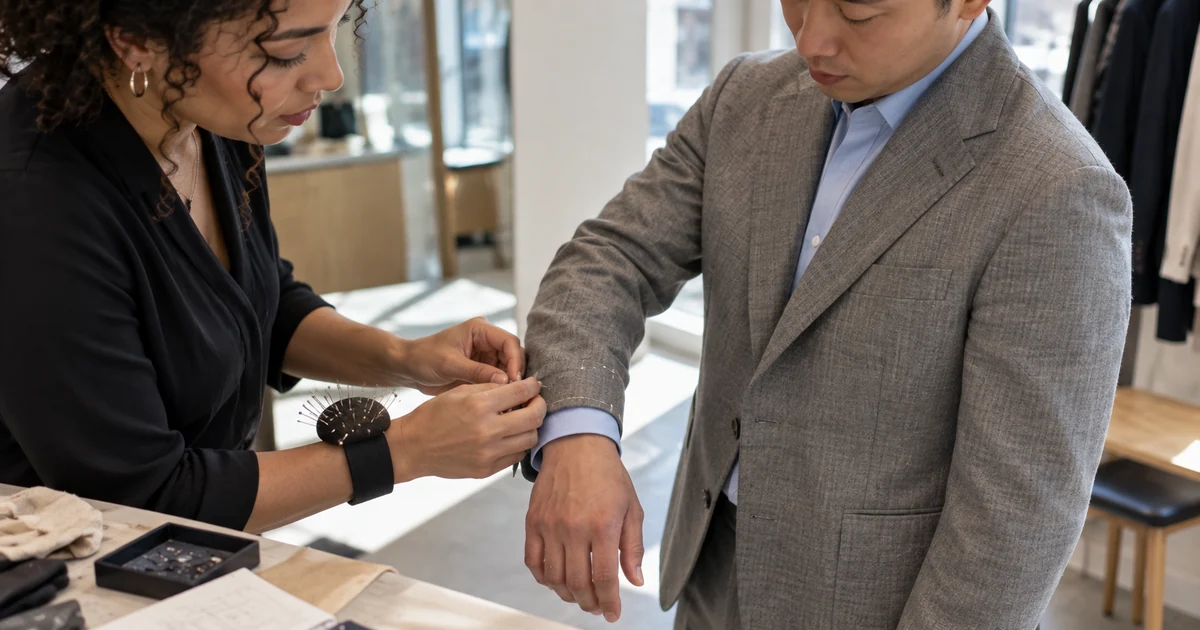
Tailor pinning grey suit jacket sleeve during fitting
Cleaning, pressing, repairs and alterations are different decisions
Suit cleaning and alterations sit close together in everyday language, yet the work is very different. Cleaning deals with soiling, pressing restores a cleaner surface shape, repairs fix local damage, and alterations change how the garment fits.
A stained jacket belongs first in the care conversation. GINETEX care symbols use the circle to guide professional dry or wet cleaning, with letters and bars giving cleaners information about solvents and process limits. A care label guides cleaning processes, not the judgement needed to reshape a structured suit. For valuable cloth, delicate fibres or an unfamiliar vintage piece, we also take seriously the advice to test cleaning on a hidden part of the garment first.
Repairs sit one step closer to alteration. Replacing buttons, securing a loose seam or tidying a small tear can be straightforward when the cloth is sound. Shortening a trouser hem asks for more judgement because length affects break, shoe choice and the line of the leg.
Fit work raises the risk. Sleeve length, jacket fit, lining tension and cloth allowance all affect the finished result, so professional suit care starts by naming the task clearly. Before you choose a tailor or dry cleaner for suit alterations, name the job in front of you.
Ask who is actually doing the alteration
A dry cleaner’s counter, the person pinning the garment and the person sewing it can be separate parts of the service. Some dry cleaners offer suit alterations through an in-house specialist or a local partner, so the useful question is who will handle the suit and how they judge the work.
Before leaving a good suit anywhere, ask plainly:
- Who will see the suit on my body before the work starts?
- Who will carry out the sewing?
- Will the finished garment be checked on me, or only pressed and returned?
- What result is realistic for this cloth and construction?
- If the alteration is unwise, will you say so before proceeding?
Those answers tell you how much fitting judgement sits behind the service. The National Careers Service describes a tailor’s daily work as starting with customer discussion and moving through pattern work, cutting and fitting. It also includes final adjustment, repairs and alterations, which is why professional tailor alterations are especially valuable when a suit needs assessment on the body.
A capable alterationist attached to a dry cleaner may be the right person for a simple job. For a valuable jacket, a wedding suit or a piece you rely on for business, we want the conversation to include limits, proportion and the expected finish before the sewing begins.

Women's cream suit sleeve alteration fitting
Pro Tip: Ask whether a second fitting is included before you agree the work. Most alterations that go wrong could have been caught on the body before the final press.
Jacket structure raises the alteration stakes
A jacket can feel tight across the chest and lift slightly at the collar at the same time. Pinning in the side seams may make the outline slimmer, yet the collar gap may still sit there because the cause lives in posture, shoulder slope or back balance.
Jacket work is connected in a way trouser work rarely is. A trouser hem has a visible line and a fairly clear endpoint. A suit jacket alteration can disturb the sleeve head, lining, chest canvas and front balance if the diagnosis starts in the wrong place.
Shoulders and sleeve heads set the upper line
Readers often ask whether suit shoulders can be altered. They can be worked on by the right tailor, but shoulder and sleeve-head changes sit among the most involved parts of jacket alteration because they affect the whole upper body line.
Sleeve pitch matters here. If a sleeve hangs at the wrong angle for the way your arm naturally rests, the jacket can crease or pull even after the sleeve length has been corrected. We look at the jacket on the body before deciding whether the issue is length, pitch, shoulder shape or something deeper in the make.
Collar, chest and balance need diagnosis
When clients ask whether a tailor can fix a collar gap, our answer starts with seeing the jacket worn properly. A gap at the back of the neck can come from several causes, including posture, shoulder slope, chest fit and the way the back hangs.
In our alteration work at Fielding & Nicholson, we handle alterations across menswear and womenswear, including sleeve shortening, trouser resizing, collar adjustments and relining work. Inclusive fit belongs in the same conversation because chest, hip, shoulder and posture differences change the right solution for each body.
A successful jacket alteration preserves balance, not just a tighter outline. That is the line between improving a suit and merely making it smaller.

Women's trouser hem fitting - Illustrative Image
Match the alteration route to the risk
When you need a suit ready for a wedding, interview or business event, the safer route depends on the risk of the alteration as much as the deadline. We sort the job first, then choose the service.
The table below compares alteration situations, safer routes and the reason each route fits the risk.
| Alteration situation | Safer route | Why that route fits |
|---|---|---|
| Cleaning, pressing, buttons or a plain trouser hem | Skilled dry cleaner or alterationist | The work is local, visible and easier to check |
| Trouser resizing or simple sleeve shortening | Alterationist or tailor, depending on garment value | Cloth allowance, symmetry and finish start to matter more |
| Jacket collar, shoulders, sleeve head or balance | Tailor with fitting and construction judgement | The visible fault may come from several connected parts of the jacket |
| High-value bespoke, delicate cloth or major body change | Tailor after a full fitting assessment | The suit’s future wear matters as much as the immediate fit |
| Old suit with worn cloth, fading or limited allowance | Careful assessment before any work | The garment may have too little potential left for a good result |
Across our Fielding & Nicholson locations in London, Manchester, Zurich and New York, we keep the same alteration judgement: the task, garment value and occasion risk guide the route. A quick hem before travel is a different decision from reshaping a jacket for a formal event.
Weight change adds another layer. Taking a suit in after weight loss can work well when the original fit, cloth allowance and proportions still support the change. If the suit has to be rebuilt around a different body, the decision becomes a stewardship question.

Pro Tip: Book the work far enough ahead that there is time to put it right. An alteration finished the day before an event leaves you no option except to wear it.
Some suits should be left alone
A suit can carry value for several reasons. It may have cost a great deal, been worn for an occasion, belonged to someone else or simply feel like the one garment in your wardrobe that still deserves care. That value earns a proper assessment, although it does not automatically make alteration the best answer.
We look first at potential. Cloth allowance, worn edges, fading, lining condition and the original cut all tell us how much honest improvement remains. An old suit with good cloth and spare allowance may reward careful work; a cheap suit with poor balance may absorb time and still sit badly.
Keeping a quality suit in use is good stewardship when the result will be worthy of the garment. WRAP has linked longer garment life with lower waste, resource use and carbon impact, which supports the instinct to preserve a good suit instead of replacing it too quickly.
Judgement also means restraint. The common misconception is simple: if a suit can be altered, the alteration is sensible. Good stewardship starts by rejecting that idea before a needle touches the cloth.

Tailor working on beige suit jacket
Questions we get asked about suit alterations
Should I bring the whole suit to an alteration fitting?
Yes, we prefer to see the jacket and trousers together. Proportion across the full suit affects sleeve length, trouser break and the way the outfit reads as a whole.
Will alterations make an off-the-peg suit look bespoke?
Good alterations can make a ready-made suit sit much cleaner on your body. The original cloth, internal make and cut still set the limit, so we judge the available improvement honestly.
Can a tailor copy the fit of my favourite suit?
A favourite suit gives useful clues about shape, comfort and proportion. We still assess the garment being altered on its own terms, because different cloth and construction behave differently.
Should I wear the right shirt and shoes to the fitting?
Yes, the right shirt and shoes help us judge sleeve length, trouser length and posture more accurately. Small changes in what you wear can alter the way a suit appears in the mirror.
Can a relined jacket feel different afterwards?
Yes, relining can change the feel of a jacket because the lining affects movement and how the garment slips over the body. We treat relining as part of fit and wearability, rather than as a purely cosmetic job.