Business attire for men
Tailored suits for the office, the boardroom and everything in between. Cut to your measurements, and built around how you actually work.
Bespoke business suits for men
Tailored suits for the office, the boardroom and everything in between. Cut to your measurements and built around how you work.
How business tailoring works
Consultations in our Mayfair showroom, at your office or home, or by video. Fittings are also available in Manchester, Zurich and New York.
Single-breasted business suits
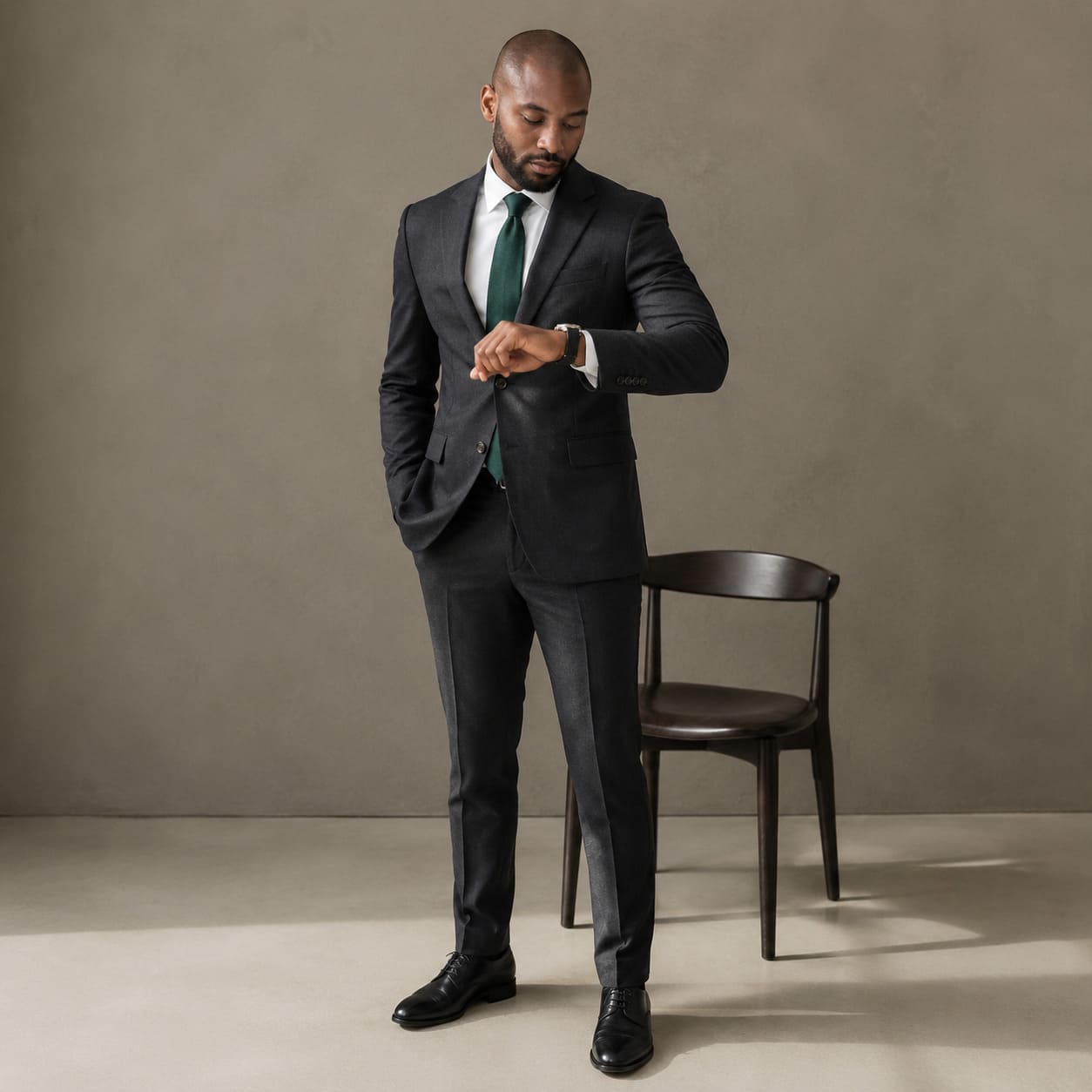
The workhorse of any professional wardrobe. Clean, simple, and easy to wear every day.
Why single-breasted
The single-breasted suit is the most common style for a reason. It has one row of buttons down the front, usually two. The cut is clean and sits close without extra bulk. It works in almost any setting, from a client meeting to a Friday lunch, and it pairs well with everything from a tie and pocket square to an open collar.
If you are building a work wardrobe from scratch or adding to one, single-breasted is the place to start. It is the most flexible option you can own.
Cloth for the office
The cloth needs to do two things: look sharp and hold up. We steer most business clients towards worsted wool. It is smooth, crease-resistant, and drapes well. A mid-weight worsted in navy or charcoal will see you through most of the year. For summer, we move to lighter open-weave wools or wool-mohair blends that breathe without losing their shape.
We source from mills like Holland and Sherry, Dormeuil and Scabal. Your tailor will help you pick a cloth that suits your climate, your commute and how often you plan to wear it.
Fit and details
We offer three cuts. Classic Fit is roomy and sits easy on the body. Tailored Fit brings more shape through the waist. Slim Fit is close and modern. Your tailor will guide you based on your build and your day-to-day. If you spend a lot of time at a desk or in a car, the cut needs to account for that.
Beyond the fit, you choose everything: lapel style, button count, lining, pockets, ticket pocket or not, cuff buttons, and the trouser finish. Nothing is standard. It is all built around what you want.
Double-breasted business suits
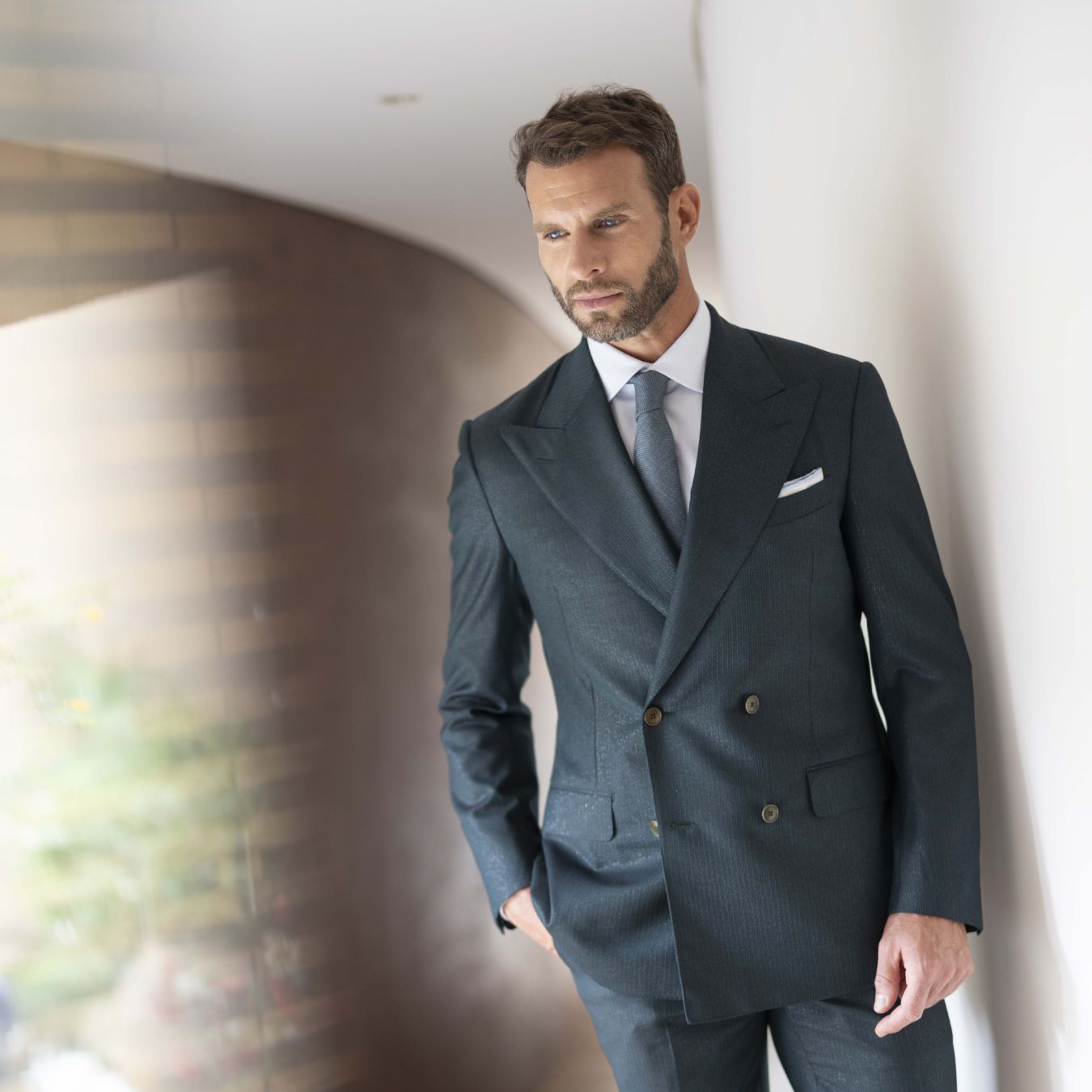
Two rows of buttons and an overlap of cloth across the front. More structured, more formal, more deliberate.
What makes it different
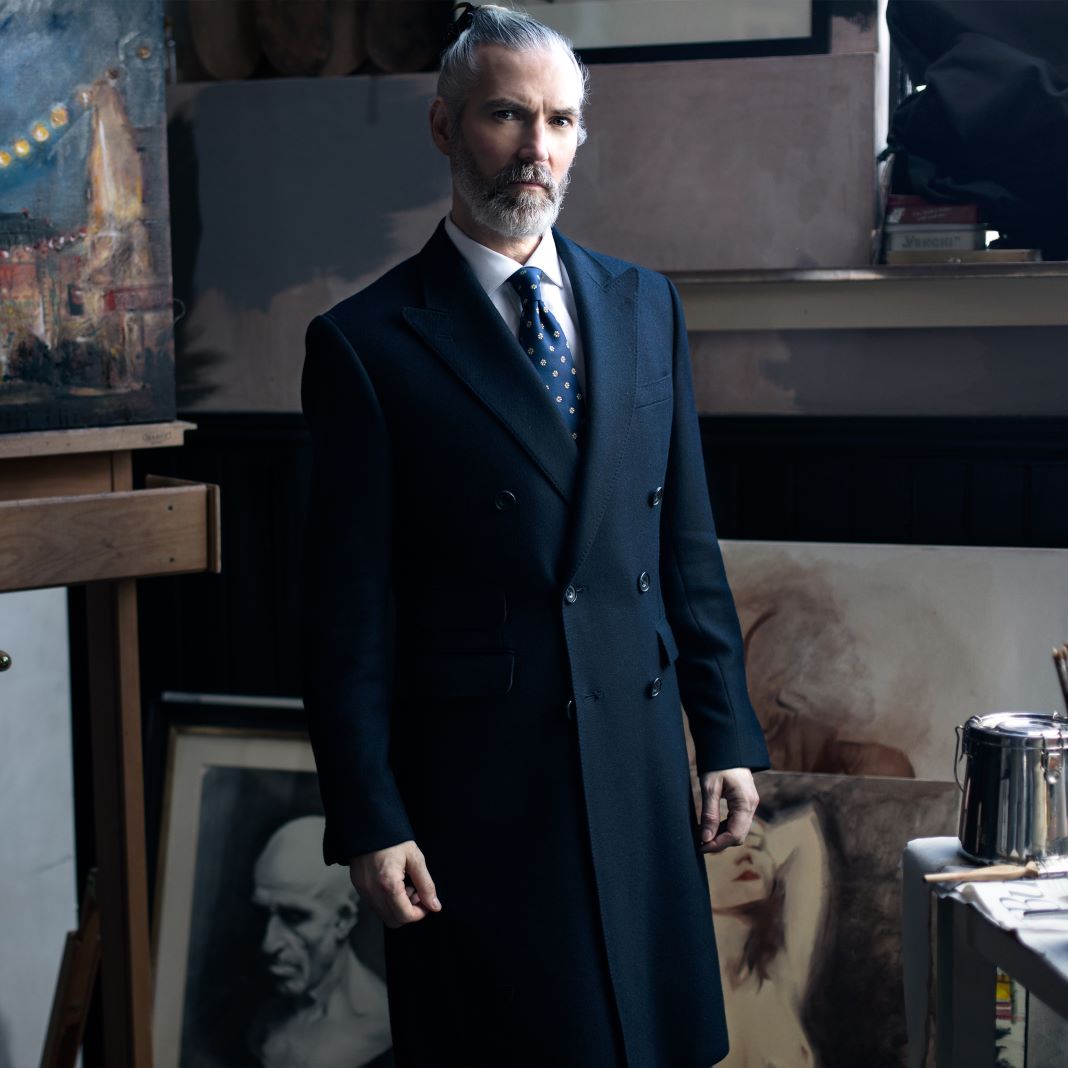
A double-breasted jacket has two rows of buttons and an overlap of cloth across the front. This gives it a wider, more structured look than a single-breasted suit. The lapels are almost always peak, which draws the eye up to the shoulders and adds shape to the upper body. It reads as more formal, more deliberate, and a bit more commanding.
Double-breasted suits were big in the 1930s, came back in the 80s, and have had a strong return in the last few years. They are no longer reserved for older men or special occasions. A well-fitted one looks sharp in a modern office.
Who it suits
The double-breasted cut tends to look best on taller or slimmer frames, where the wider front stays in proportion. That said, with the right tailoring, most body types can carry it well. We adjust the button spacing, lapel width and jacket length to make sure everything sits right on you.
One thing to know: a double-breasted jacket should stay buttoned when you are standing. It is cut to look its best that way. If you want something you can throw open and leave unbuttoned, stick with single-breasted.
Styling
Keep the rest simple. A double-breasted jacket does the talking on its own. A plain white or pale blue shirt, a clean tie, and minimal extras. Skip the belt and go for side tabs or braces, which sit cleaner under the overlap. And skip the waistcoat too. The extra layer at the front means you do not need one.
Three-piece business suits
A two-piece with a matching waistcoat. That extra layer changes the whole feel.
What the waistcoat does
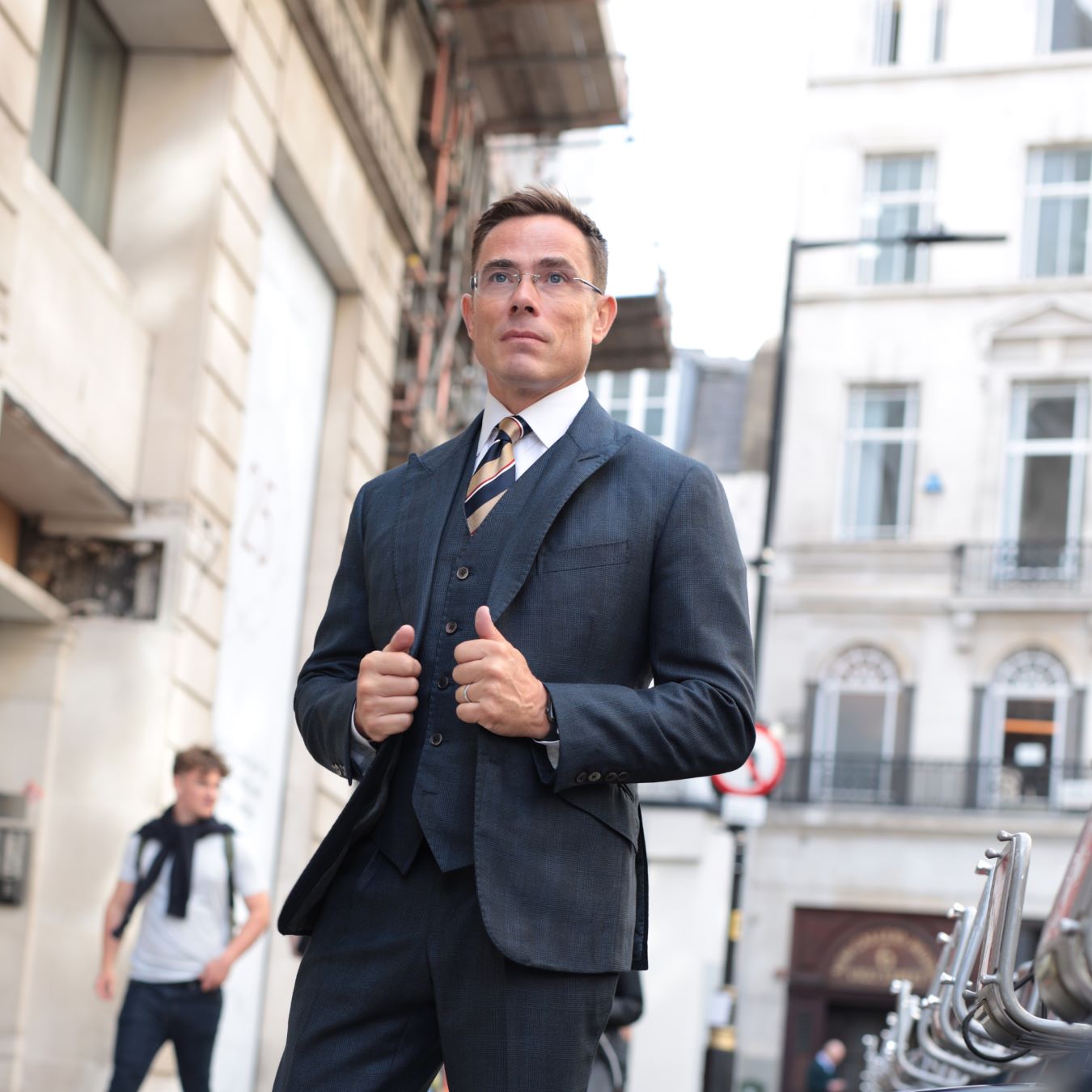
A three-piece suit is just a two-piece with a matching waistcoat. But that extra layer changes the whole feel. It adds structure to the front of the suit, keeps your shirt and tie sitting flat, and gives you the option to take your jacket off without losing the look. In a warm office, a meeting room, or a long day, that matters.
It also lets you dress the suit up or down depending on the moment. Jacket and waistcoat together for a meeting. Waistcoat only for your desk. Jacket only for drinks after work. One suit, three looks.
Waistcoat styles
Most business waistcoats are single-breasted with five or six buttons and a low V-front. This is the clean, classic version that works under any jacket. If you want more character, we can go with a higher cut, a double-breasted waistcoat, contrast cloth, or a different back.
Questions about your work wardrobe?
Fill in the form and we will get back to you. Tell us what your week looks like, how much you travel and where your current suits fall short.
Ask about cloth weights, how many suits you actually need, or what it costs. If it is easier to talk, leave your number and we will call.
We are in London (Mayfair), Manchester, Zurich and New York. We can come to your office, or start with a video call.
Business suit questions
The things men ask us most often before they order a suit for work, and the answers we give.
What do Super 110s, 130s and 150s actually mean?
The super number tells you how fine the wool fibre is, not how good the cloth is. The higher the number, the thinner and softer the yarn, and the smoother the finished cloth feels in your hand. What almost nobody is told is that fineness is bought at the cost of durability. A Super 150s or above feels wonderful, but it creases more readily, it shines at the stress points sooner, and it wears through faster. For a suit you put on every week, Super 110s to Super 130s is the sensible range. Save the higher numbers for a suit you wear once or twice a month. Once cloth is being cut to your own measurements, the fit will do far more for how you look than the number on the label. You can see the ranges we work with in our collections.
What is the difference between a fused, half canvassed and fully canvassed jacket?
It describes what is holding the front of the jacket in shape. A fused jacket has a stiffening layer glued to the back of the cloth. It is quick and cheap to make, it feels boardy, and over the years it can bubble or lift away. A canvassed jacket has a separate layer of horsehair canvas stitched in, floating between the cloth and the lining. It moves as you move, and it slowly takes the shape of your chest, which is why a canvassed jacket often fits better after five years than it did on the first day. Half canvassed means the canvas runs through the chest and lapels and the rest of the front is fused. Fully canvassed means it runs the whole length. You can check a jacket yourself: pinch the cloth a few inches below the bottom button, one finger inside and one outside, and pull gently. If you can feel a loose third layer between the two, there is canvas in there.
I am starting a job with a suit dress code. Which suit should I get first?
Navy first, charcoal second, mid-grey third. Navy is the single most useful suit you can own. It works in daylight, it flatters most people, and it takes almost any shirt and tie you put with it. Charcoal is the natural second because it is a shade more serious, which helps in a formal or client-facing setting. Only once you have both is it worth adding a check, a stripe or a lighter grey. If you can afford one suit and one only, make it navy, and put the money into the fit rather than into a third colour.
How many business suits do I need for a five-day week?
Three at a minimum, five if you can manage it. Wool needs roughly 24 to 48 hours to recover its shape after a day of wear, so a suit worn on Monday is better left until Wednesday. Three suits in rotation gives each one a proper rest. Five means each is worn about once a week, and each will last years longer as a result. It sounds back to front, but owning more suits makes every one of them wear out more slowly, so the cost per year of wear goes down rather than up.
Can I wear a black suit to the office?
Usually not, and it is the most common mistake we see. Black sits near the top of the formality scale, and it is traditionally an evening and funeral colour rather than a working one. Under office lighting and in daylight it reads stark rather than sharp, and it needs high contrast to look right, which limits your shirts and forces black shoes every time. Navy and charcoal do the same job better and are what almost every business dress code has in mind. Keep black for evening events and the occasions that call for it.
How much break should my trousers have?
The break is the fold the trouser makes where it meets your shoe, and it is one of the last things your tailor sets. There are four rough positions. No break, where the hem just kisses the shoe and a little sock shows when you stand. A quarter break, one small crease. A half break, a light fold resting on the shoe. A full break, a generous fold. For a business suit, a quarter or half break is the safe ground, current without looking fashion-led, and flattering on most builds. No break can read as trendy in a conservative office, and a full break needs a wider trouser to carry it properly. Bring the shoes you will actually wear with the suit to your fitting, because changing the shoe changes the break.
Can I wear the jacket on its own with odd trousers?
You can, but it rarely looks as good as people hope. A suit jacket and its trousers are cut from the same cloth and are meant to age at the same rate, so wearing the jacket twice as often leaves you with two halves that no longer match. A smooth business worsted also has very little texture of its own, so on its own it tends to read as an orphaned suit jacket rather than a blazer. If you want a jacket that genuinely works with odd trousers, it is worth having one made for that job in a cloth with more surface interest. Our casual wear page covers those.
Why does the seat of my trousers go shiny, and can it be fixed?
Shine is crushed wool. Friction and pressure flatten the tiny fibres on the surface until they reflect light instead of scattering it, which is why it appears first on the seat, the inside thighs and the elbows. Sitting on leather car seats and office chairs speeds it up, and so does heavy pressing at the dry cleaner. Light shine can sometimes be lifted by steaming through a damp cloth and brushing the surface back up, but once it is set into the weave it does not really come out. Prevention is the only reliable answer: rest the suit between wears, brush it down, and clean it rarely. Because it is nearly always the trousers that go first, ordering a second pair at the same time, in the same cloth from the same batch, is the single most effective thing you can do, and matching that cloth years later is often impossible. If your trousers have already gone, our alterations service can tell you whether anything can be saved.