What should you expect from Pitti Uomo 2026 in Florence?
You should expect far more than a standard menswear trade show. Pitti Uomo in June brings together tailoring houses, fabric mills, buyers, editors, and well-dressed attendees in a setting where style is observed in real life, not just presented on a runway. The event matters because it shows how menswear is actually being worn, discussed, refined, and quietly moved forward.
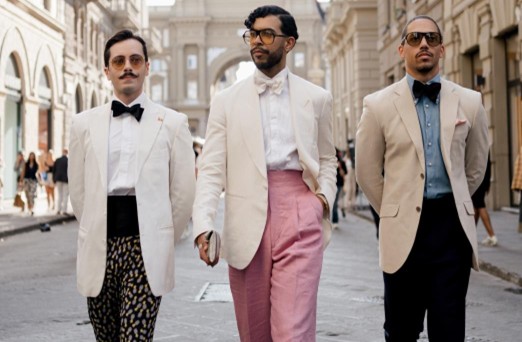
Cream linen summer suits with bow ties Florence
What Is In This Article
How Does Pitti Uomo Challenge What Most People Think About Menswear Shows?
The common mistake is to assume Pitti Uomo is simply a busy industry fair with better photography.
That impression usually comes from seeing images outside the Fortezza da Basso: sharply dressed groups, summer jackets, polished shoes, flashes of colour. From a distance, it can look like a performance. In person, the atmosphere is much closer to a working gathering built around cloth, cut, and conversation.
A typical trade show culture often centres on stands, schedules, and transactions. Pitti Immagine certainly includes those elements, yet the Florence menswear scene gives the event a different character. People pay attention to how a jacket moves in heat, how linen creases through the day, how a trouser line changes with a softer shoe, and how personal style sits between tradition and ease.
That shift in perspective is what catches newcomers out. They arrive expecting spectacle and leave remembering the quieter details, such as a beautifully judged lapel, a sun-faded tie, or a shirt collar that sits just right without looking forced.
Florence plays its part as well. Warm light, old stone, and summer weather make tailoring look less ceremonial and more lived in, which changes the way many people read menswear from the start.
What Actually Happens at Pitti Uomo in June?
A day at Pitti Uomo usually unfolds through movement rather than theatre.
Attendees pass between exhibitor spaces, informal meetings, collection previews, and chance encounters that turn into long discussions about fabric, pricing, fit, and demand. Designers show upcoming work, textile mills present seasonal developments, buyers assess what may translate into retail, and journalists spend as much time observing people as they do studying products.
One hour may be spent inside a stand looking at new cloths with a mill representative. The next may involve a conversation in a courtyard about jacket construction, shirt proportions, or why certain colours keep returning each summer. That rhythm gives the event its shape.
Runway presentations can form part of the wider schedule, but they are not the whole story. Much of the real activity sits behind the scenes of Pitti, in trade show activities that feel practical rather than dramatic. Decisions are tested in real time. Fabrics are handled. Opinions are exchanged quickly and sometimes revised by the afternoon.
Outside the formal showcases, style observation becomes part of the working day. Buyers, tailors, and editors notice what people are actually wearing because that offers a useful reading of the season. If several experienced dressers are leaning into softer jackets, fuller trousers, open collars, or lighter shades, people notice. That kind of visual evidence often carries more weight than a single presentation.
For a tailoring house such as Fielding & Nicholson, the interest in an event like this would sit naturally in that exchange of ideas: not in chasing novelty, but in seeing how fabric, fit, and personal taste are being interpreted across the menswear gathering.
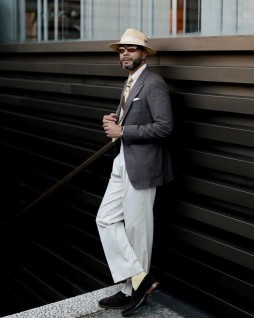
Brown linen jacket wide grey trousers straw hat
Why Has Tailoring at Pitti Uomo Become More Relaxed?
Picture two suits in June. One is heavily structured, dark, and formal enough to feel sealed off from the weather. The other is cut with less padding, a softer shoulder, lighter cloth, and room to move. In Florence, the second one makes immediate sense.
Relaxed tailoring has become more visible at Pitti Uomo because modern wardrobes have changed. Many men still want the shape and confidence that tailoring provides, but fewer want stiffness for its own sake. Soft construction answers that shift without abandoning standards.
Climate has helped push that change into view. Lightweight fabrics, including linen, high-twist wool, cotton blends, and open weaves, behave differently in summer. They breathe more easily, crease more honestly, and often look better with movement. Once those qualities are seen repeatedly in a setting like Florence menswear week, they stop looking casual in a dismissive sense and start looking appropriate.
Colour matters too. Deep business tones can still look excellent, though June often favours tobacco, cream, washed blue, olive, stone, and pale grey. Those shades sit naturally with sunlight, which means the wearer appears considered rather than overdressed.
Another reason for the shift is comfort. Softer tailoring lets people sit, walk, travel, and socialise without looking trapped inside the suit. British tailoring houses and Italian tailoring traditions have both responded to that reality in different ways, yet the direction is shared. Experienced bespoke tailors understand that elegance depends on movement as much as silhouette.
Fielding & Nicholson sits within that broader conversation through its emphasis on fit and long-term wearability, which means the point is never to make tailoring looser for fashion alone. The point is to make it feel right on the body and useful in real life.
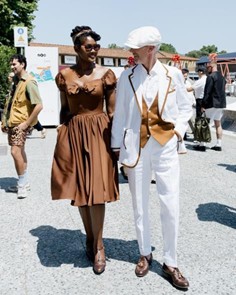
Cream summer suit with straw flat cap
What Details Set Apart the Best Looks at Pitti Uomo?
The strongest looks at Pitti Uomo are often the least noisy.
A softly cut jacket in the right cloth can hold more presence than a louder outfit with brighter colour and extra accessories. That is partly because good style reads clearly at a glance. You notice proportion first, then drape, then the smaller touches.
Fit does most of the work. Sleeves that break in the right place, a collar that sits cleanly against the neck, trousers with enough shape through the leg, and a jacket length that balances the wearer all change the impression before anyone registers the label. An experienced cutter sees those points immediately because they decide whether clothes feel settled on the person.
Cloth comes next. Dry wool, crisp linen, brushed cotton, or a fresco weave all create different effects even in similar colours. Fabric merchants and bespoke tailoring houses pay close attention to this because texture often gives an outfit its depth. Muted tones can look rich when the cloth has character, whereas a brighter shade in a flatter fabric can look oddly empty.
Styling finishes the picture, but restraint usually wins. A knitted tie, an open collar, a pocket square with little fuss, or the choice of darker loafers against a light suit can be enough. The best dressed at Pitti Uomo rarely look as if each element is demanding separate attention. Everything is pulling in the same direction.
That is why standout menswear in Florence so often looks simple in photographs and much better in person.
How Does Pitti Uomo Shape the Future of Menswear Beyond the Event?
Pitti Uomo influences menswear by making gradual change visible before it becomes widespread.
Buyers and designers use the event to assess more than products. They watch which cuts feel current, which fabrics are gaining traction, and which styling choices seem natural on real people. Those observations then filter into buying decisions, collection planning, editorial coverage, and retail presentation over the following seasons.
One clear example is the steady acceptance of softer tailoring. Unstructured jackets and easier trousers did not appear overnight, nor did they arrive from one source alone. Even so, Pitti gave those ideas a public setting where they could be seen repeatedly, tested socially, and treated seriously by the wider industry.
Lighter palettes have followed a similar path. Seasonal fabrics in stone, ecru, sage, washed navy, and brown have become easier to read because people have watched them work in context. Once enough menswear designers, international buyers, and tailoring ateliers respond to that context, the shift moves outward into shops and wardrobes.
Fabric producers play a quiet part in this process. If mills show cloths that support softer silhouettes or warmer weather dressing, and those cloths spark interest, they influence what becomes possible later. The future of menswear often begins with material choices before it appears as a visible trend.
For readers who never attend, that influence still matters. What shows up months later in a department store, a tailor's book, or a seasonal campaign has often passed through places like Florence first, refined by use rather than declared by slogan.
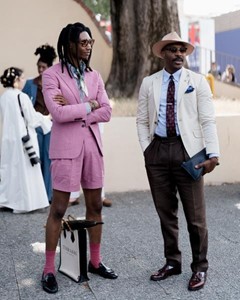
Pink linen shorts suit men's summer style
What Is the One Thing to Prioritise When Interpreting Pitti Uomo’s Impact?
The most useful way to read Pitti Uomo is to look past novelty and watch for authenticity in dress.
Menswear changes, proportions shift, and seasonal fabrics come and go. Yet the people who leave the strongest impression are usually the ones whose clothes feel convincing on them. Their jackets fit properly, their fabric choices suit the weather, and their styling reads as personal rather than borrowed.
That is why craftsmanship remains so important within the bespoke tailoring community and beyond it. A well-cut garment does not need spectacle to justify itself. It has shape, ease, and purpose, which means it keeps its value even as the mood of menswear moves around it.
The enduring lesson from Florence is straightforward: fit and sincerity outlast fashion noise, because clothes only become stylish once they look fully at home on the person wearing them.