Why does a jacket feel tight across the back?
A jacket often feels tight across the back due to poor alignment between the garment’s cut and the wearer’s posture, shoulder width, or movement needs. Common causes include low armholes, narrow back panels, or incorrect seam tensions that restrict mobility when lifting arms or reaching forward.
Where tightness often begins
For many, the discomfort becomes clear in everyday situations: reaching to shake someone’s hand, adjusting a watch, or stretching slightly while seated. If a jacket pulls across the shoulder blades or tugs at the upper arms, the back may be too tight or poorly constructed.
Several common culprits can lead to this feeling:
- Shoulders that are too narrow for the wearer’s frame
- Armholes that sit too low or too tight, restricting upward movement
- Back panels with little or no ease, creating strain when moving
- Fabric tension at key seams that limits flexibility
- A mismatch between the wearer’s posture and the jacket’s cut
Some tightness may also develop over time due to changes in body shape, particularly around the upper torso. In contrast, well-made bespoke jackets rarely exhibit these problems because they are built with an knowledge of the wearer’s natural stance and shoulder rotation.
What Is In This Article
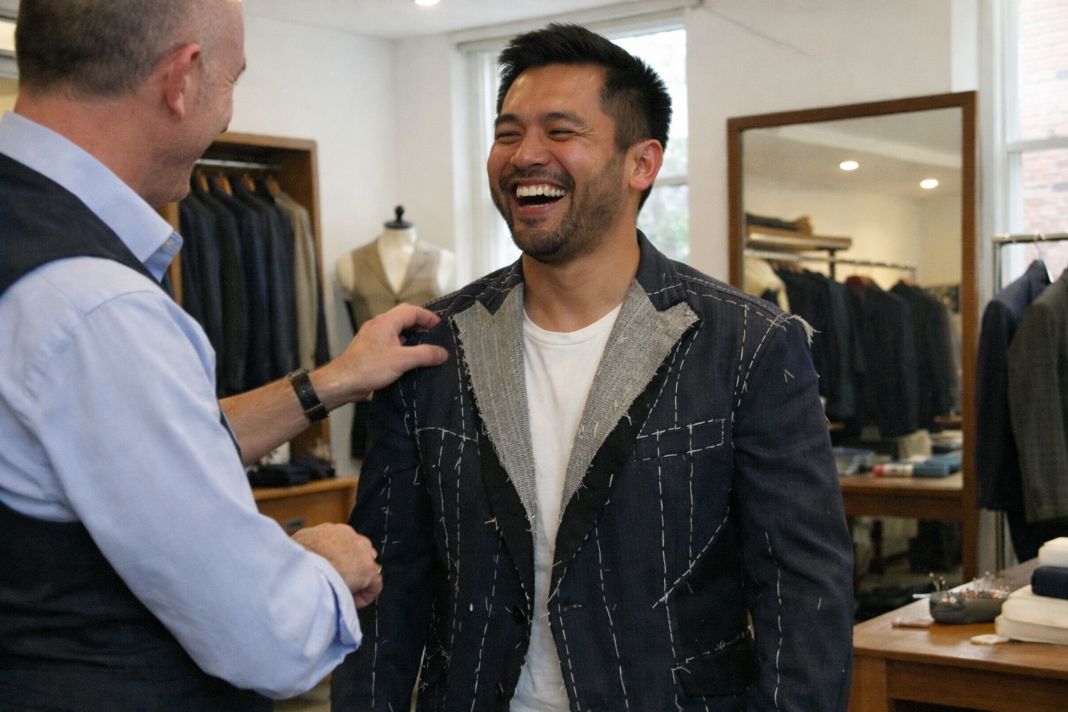
An illustrative photo of a casual fitting session in a London tailoring showroom
Why armholes and shoulder construction matter
The armhole and shoulder area is where architecture meets anatomy. A well-cut shoulder and precisely shaped armhole can dramatically improve the way a jacket moves with the body. Conversely, flaws in these areas are often the root cause of back tightness.
Armholes: Higher for freedom
Contrary to intuition, a higher armhole usually provides greater mobility. When the armhole sits closer to the armpit, the sleeve can move more freely without dragging the rest of the jacket. Low or oversized armholes might feel relaxed when at rest but pull or twist under motion.
Sleeve pitch: Mapping natural movement
Sleeve pitch refers to the angle at which the sleeve is attached to the body of the jacket. If this angle does not match the natural hang of the wearer’s arms, fabric tension often builds across the back when raising or rotating the arms.
Shoulder structure: Balance and movement
Shoulder padding, slope, and width all play a part in mobility. Too much padding or incorrect shoulder slope can misalign posture within the jacket. In bespoke tailoring, these details are carefully evaluated and balanced across fittings to work with, not against, the way a person moves.
When constructed properly, the armhole and shoulder function like well-placed hinges: they enable movement without structural compromise.
Pro Tip: Letting out seams works only if there is enough allowance left in the original construction.
How tailors identify mobility issues
Before any needles or scissors come out, a skilled tailor begins with observation. Knowledge what causes discomfort requires both technical knowledge and empathy.
A typical diagnosis includes:
- Movement tests: The tailor may ask the client to raise their arms, mimic reaching gestures, or rotate their shoulders while wearing the jacket.
- Mirror assessment: With the client facing a mirror, the tailor watches how fabric behaves, looking for folds, pulling or gaping along seams.
- Posture analysis: A natural stance influences how a jacket sits. Tailors examine spine alignment, shoulder roll, and arm curve.
- Pinning and marking: If adjustments are needed, the tailor will pin specific areas to visualise changes before altering permanently.
- Fit history: For returning clients, tailors often compare how garments have evolved over time, accounting for any changes in build or usage.
At Fielding & Nicholson, clients often experience this process in a calm, private showroom where fittings are unhurried. The goal is to fix the garment, but to understand the wearer’s needs thoroughly.
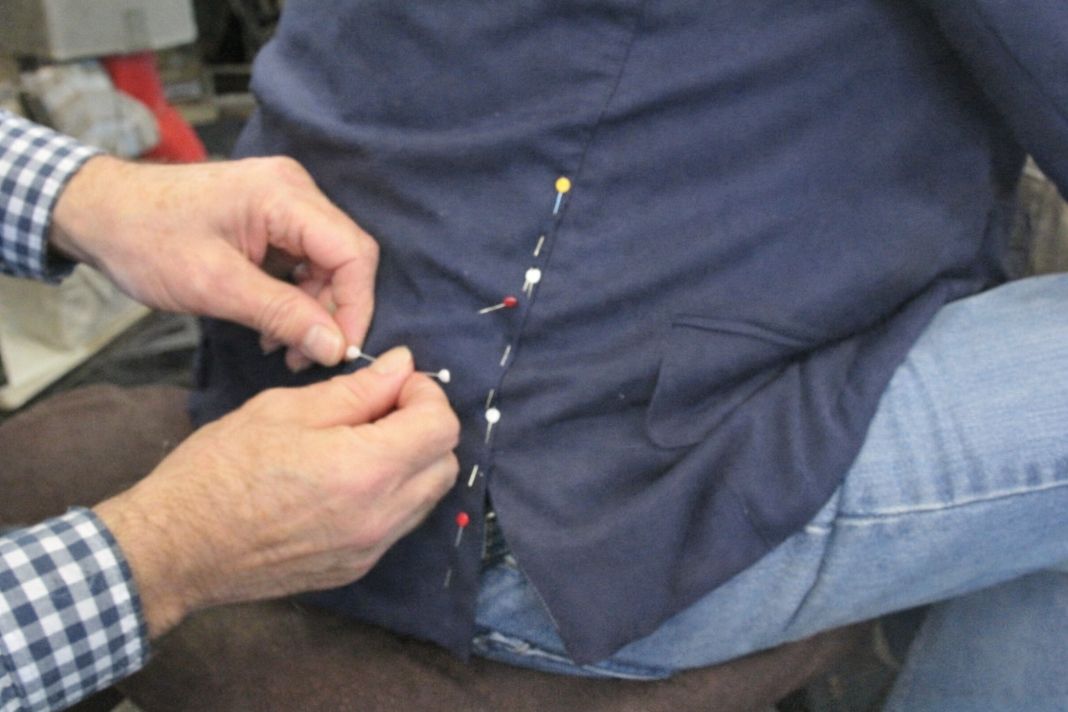
An illustrative photo of a close-up view of a tailor pinning the side seam of a navy jacket worn by a seated client.

Pro Tip: A sleeve pitch that mirrors your natural arm hang can prevent fabric tension when reaching or lifting.
5 common tailoring fixes for back tightness
Many jackets can be improved with targeted alterations. When handled by an experienced tailor, these changes restore comfort without disrupting the jacket’s overall appearance.
- Letting out the back seam or side seams If seam allowances permit, extra fabric can be released to provide room across the back and lower shoulder blades. This is often the first option for mild tightness.
- Adjusting the armhole or sleeve pitch When arm movement is strained, recutting the sleeve angle or reshaping the armhole opening can correct tension. This is particularly helpful when sleeves lift the jacket body unnaturally.
- Re-cutting the back panel In more complex cases, the entire back piece may be reshaped to allow greater ease across the shoulder blades. This is a significant adjustment often reserved for higher-end garments or bespoke pieces.
- Adding a discreet pleat or bi-swing panel Some jackets can benefit from a small expansion fold at the back, often seen on field jackets or sporting styles. This addition allows more freedom without compromising the overall silhouette.
- Rebalancing for posture If the wearer stands or sits in a way that differs from average patterns, the jacket may need to be rebalanced. Adjusting the shoulder slope or matching the centre back length to the spine curve can make a meaningful difference.
Not every fix is suitable for every jacket. The material, construction and condition of the garment all guide what is possible.
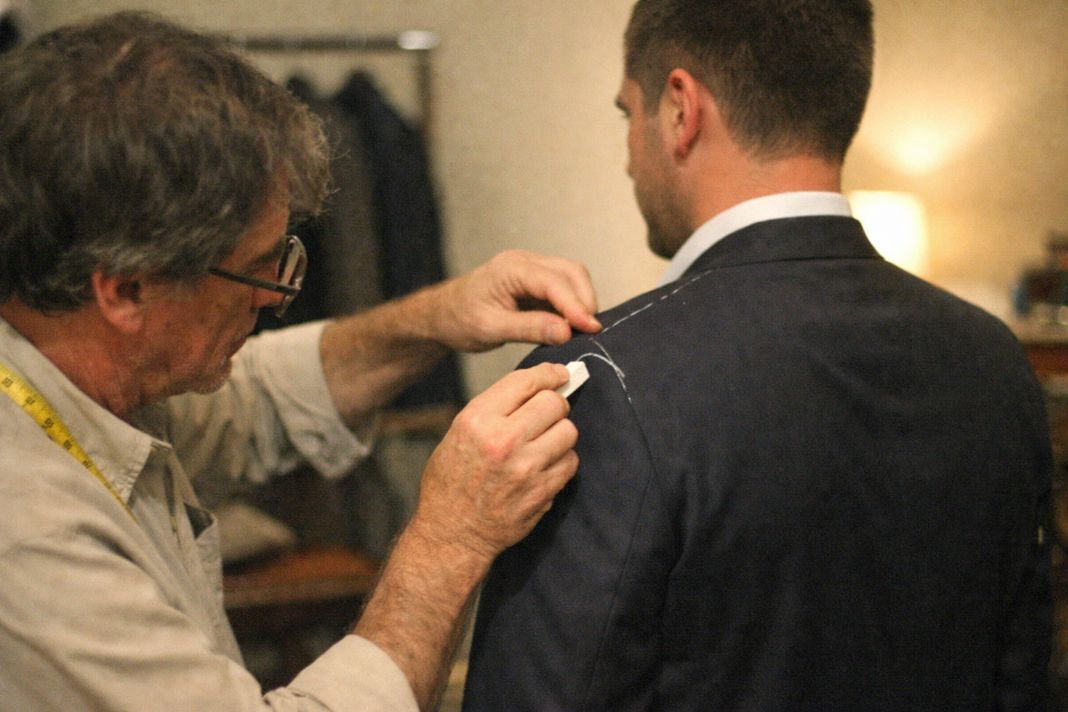
An illustrative photo of a tailor gently marking a man’s jacket near the shoulder during a fitting in a softly lit private showroom
When a jacket can’t be fixed
While many fit problems can be resolved, some jackets reach a point where further alteration risks damaging their integrity.
Here are signs that a jacket may not be worth adjusting:
- The seams have already been let out fully, with no fabric remaining.
- The garment was originally fused or glued with little structure to alter.
- The style or cut is fundamentally incompatible with the wearer’s build.
- Multiple previous alterations have distorted the jacket’s balance.
When these issues arise, a bespoke replacement becomes the more sensible option. Rather than continuing a cycle of compromise, starting fresh allows every element, from posture fit to cloth weight, to be adjusted from the ground up.
Fielding & Nicholson approaches this thoughtfully, often advising clients on wardrobe planning that prioritises long-term comfort and adaptability.
Bespoke tailoring prevents tightness by design
Instead of addressing problems after they arise, bespoke tailoring addresses mobility concerns from the outset. The entire process is designed to avoid restriction and discomfort.
Fittings are spaced over several weeks, with each session refining the interaction between garment and wearer. A bespoke pattern accounts for body measurements, but also for shoulder slope, arm rotation, and natural posture.
Many tailors, including those at Fielding & Nicholson, carefully select cloth based on drape and flexibility. For clients who require additional adjustment, whether due to mobility differences, gender inclusivity or past fit challenges, bespoke methods adapt accordingly.
By drafting from scratch, tailors remove guesswork. Freedom of movement becomes a built-in property, not a feature retrofitted after discomfort has already occurred.
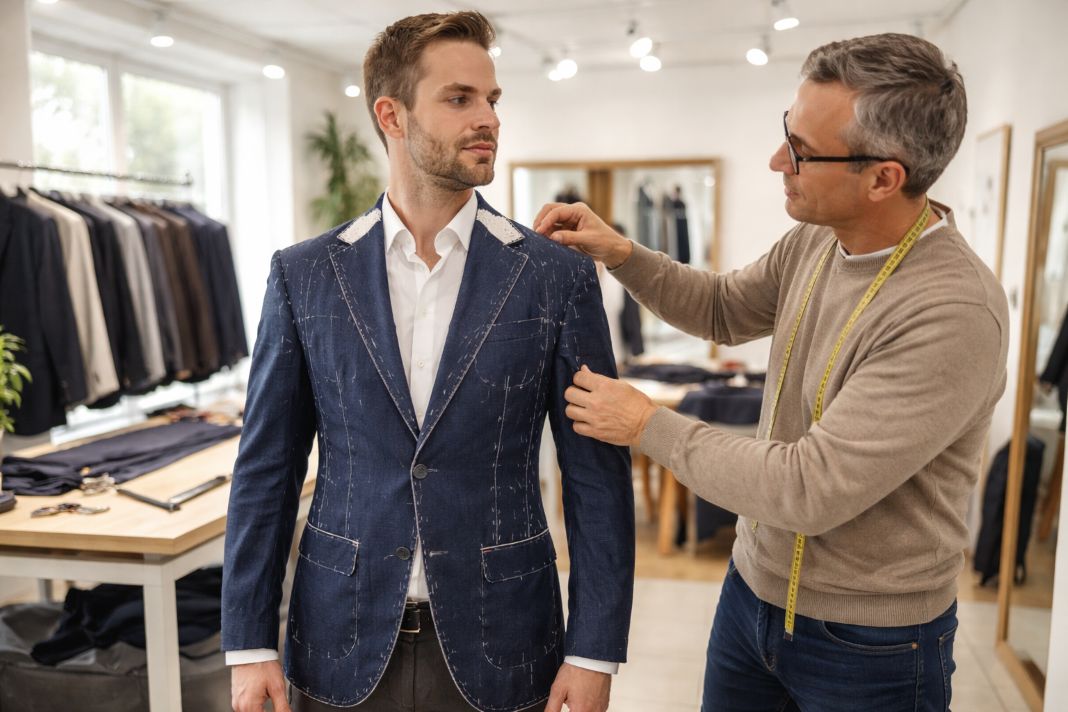
An illustrative photo of a client trying on a half-finished suit during a basted fitting session
What it’s like to work with a tailor
If you have never had a jacket made or fitted by a tailor, the process may feel unfamiliar, but it is often far more relaxed and personal than most expect.
Here’s what typically happens:
Initial consultation You meet in a quiet, private space to discuss your style, needs and preferences. The tailor listens closely, then takes detailed measurements and posture notes. Cloth options are shown, but no decisions are rushed.
First fitting A partially made garment, known as a baste fitting, allows you to try the structure. Adjustments are marked directly on the garment as you move naturally.
Intermediate fittings Over one or two further sessions, refinements are made. This includes shoulder slope, sleeve pitch and mobility adjustments to fine-tune both comfort and appearance.
Final delivery Once complete, the jacket fits not just your body, but the way you live and move. Tailors often invite you back after wearing the garment for a time to consider any long-term changes.
Across locations like London, Zurich, Manchester and New York, Fielding & Nicholson provides this experience with consistency, balancing tradition, privacy and a strong client relationship.
A jacket that moves well feels invisible when worn. That’s the real test of tailoring, not just how it looks, but how it lets you live freely.